
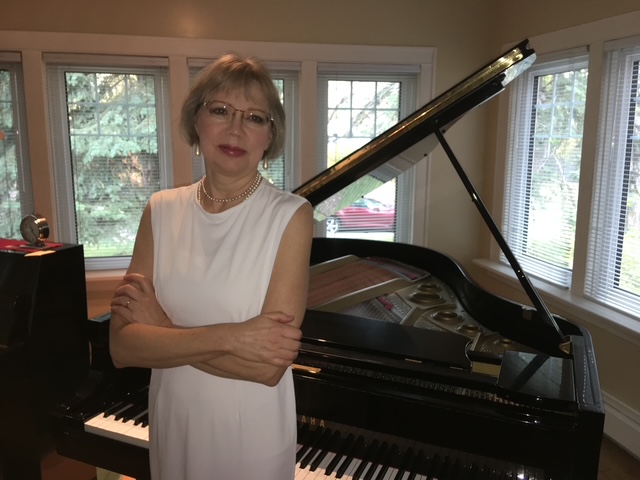
Janice Elliott-Denike
On Teachers and Teaching: Part One
by Janice Elliott-Denike
Following a request from our Provincial Executive to write one or two articles about my teachers, and teaching (an honour and a daunting task!), here is my attempt. Part One outlines who my teachers were. Part Two will outline what one does with that teaching: how does one use it, and (hopefully) build on it?
Before formal lessons, I was already playing the piano easily by ear, from age 5, accompanying my father who was extremely musical. Our home was filled with good music. We all sang a lot, too. Playing and singing by ear was a fine beginning that I wish more students had. It makes all formal training comfortable and natural.
My first teacher, Evelyn Mullock, of Kindersley was an English lady (whose husband had ridden in Lawrence of Arabia’s Camel Corps!) who taught many students and was the best teacher in our area then. Whatever her training in England was, she was utterly reliable (she never missed a lesson) and gave a good foundation. Technique was always done at the beginning of every lesson. All pieces were RCM. A clock was on the top of her piano to help her stay on time. She prepared us for RCM exams and always entered her students in Kindersley’s music festival, sitting at all of the classes, day after day, taking notes. She was a calm, gently-spoken person; I always looked forward to lessons because I was consumed with piano and music in general. She assigned many new pieces every week because I learned them all very quickly.
Next was Donna Thomson in Alsask. She taught me from age 13 – 18 and I was very grateful for all that she did. During those years she resumed her own studies and attained her ARCT Teacher’s Diploma, taking lessons in Saskatoon with Marylou Dawes (Kolbinson) and also consulting Walter Thiessen for advice on pieces to assign me. Thanks to them, I learned good repertoire, and bought piano scores in reputable editions (Henle, Durand, Peters, etc). Donna also started every single lesson with technique. She was thorough about sight-reading. She valued RCM exams and music festival, and always consulted their rules and requirements very carefully, every single time (an important example that I’ve always followed). Donna also loaned me her classical recordings, including large box sets, which I listened to avidly, also reading the included booklets. For example, I listened to entire Mozart operas, following the libretto. Donna also loaned me ‘The Oxford Junior Companion to Music”, which I devoured, cover to cover (it’s how I discovered I have perfect pitch). It was an excellent book, not ‘dry’ at all. Donna was energetic, forthright, vivacious, and spunky. She taught me all of my theory and history as well. She always attended concerts and was an adventurous cook and reader. We were very fortunate that she lived in our area, as our family could not manage the long trips to Saskatoon for lessons. Donna joined the SRMTA and served it in many ways, including as President. I first learned of the RMTs and SRMTA from her.
Then, it was Professor William Moore at the University of Regina. He was an outstanding pianist and teacher—the most important and influential of all my teachers. He attracted many students to Regina and produced many fine pianists. Originally from South Carolina, he studied with two famous teachers: Cecile Genhart (Eastman) and Rosina Lhevinne (Juilliard), and passed on their teachings very thoroughly to his students, particularly the ‘Genhart Principles’ which have been essential to us who were fortunate enough to learn them. (I use them all the time with my students). Professor Moore was an exciting, intense, demanding, meticulous, musical teacher. Every piece I studied with him was extremely well-taught and learned. Every note had to be considered, thought through, and listened to. Every page was ‘black’ with markings. He not only taught what to do but also how to do it and WHY. This ‘WHY’ was one of the very best things, because otherwise one doesn’t really learn completely what to do, nor learns how to THINK and LISTEN to everything and eventually be able to figure
things out for oneself. I explain all of this to every student. It’s not enough to say, “Do this,” but explain WHY. His students had to be perfectly prepared for every lesson (those who weren’t were kicked out), but we got along very well. I worked very hard, because it was exactly the teaching I wanted—and if you worked hard for him, he worked hard for you. Mr. Moore was also an excellent performer and played a lot. He had a real following in Regina and around the province. He played a solo recital every autumn for years, which was a big event. He was an intense, musical, passionate, exciting performer, and his concerts were wonderful. Because of his own experience, he gave excellent advice about how to prepare for a performance and what to do on the day of a concert; how to adjust to the hall and how to project and pedal accordingly; how to work with a conductor; and how to be heard above an orchestra in certain moments and passages. He also discussed the great pianists: their strengths and characteristics. Years later, we performed Poulenc’s d minor Concerto for Two Pianos on a season-opening concert, which was a special collaboration. He was a faithful supporter and mentor over the years. His sudden death in 2005 shocked us all.
After Professor Moore, it was Dr. Ernesto Lejano in Edmonton. He was a highly respected teacher at the University of Alberta for many years and produced many fine students. A native of Manila, he studied in Spain and then with Cecile Genhart (Eastman) for his Graduate and Doctoral degrees. He had very wide knowledge and a scholarly background and aura. Among other things he was a ‘Mozart specialist’, because of his doctoral thesis at Eastman – so naturally I wanted to study Mozart with him (besides other pieces). He was also a gracious mentor in subsequent years whenever I needed advice. He was a loveable, colourful gentleman. His sudden death left a big hole in my music life.
Next was Herbert Stessin (Juilliard) at the Aspen Festival. A student of Adler, Iturbi and Gorodnitzki, he became the latter’s assistant at Juilliard and then a professor there in his own right. One of his specialties was very advanced technique (he was known as ‘The Fixer’ at Juilliard, because students said he could fix any technical problem). I wanted to study with him to learn that technique, especially as it was helpful for pianists with smaller hands. It involved minute adjustments of the hand’s angle to minimize any unnecessary pivoting in the hand during patterns or passages. It is a very smart, efficient way of playing, which makes many things easier.
Lastly, I spent several summers at Banff’s Summer Keyboard Festival, observing lessons and masterclasses of Marc Durand and Julian Martin. It was very useful. I took many notes and copied many things into my scores upon returning home, playing and thinking about broader applications.
Professor Moore, Dr. Lejano and Mr. Stessin all emphasized ‘Economy of Motion’, which is so important: intelligent, efficient use of the hands and body. Physical efficiency with relaxation means no wasted effort, better control, and a better sound.
Every day I am so grateful for each of these teachers, and I prize everything they did for me. It’s been a privilege to pass it on.