
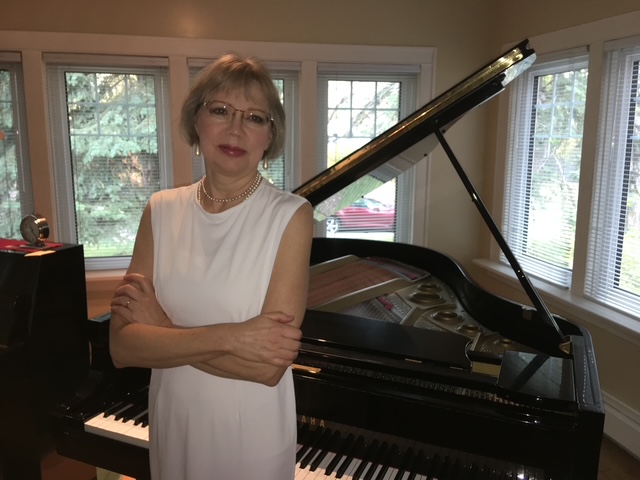
Janice Elliott-Denike
On Teachers and Teaching: Part Two
by Janice Elliott-Denike
As requested, here follows an article on teaching: what one has learned and does. Such a vast topic can obviously only ‘scratch the surface’ and mention a few things. Bear with me…
I did not teach at all until after university, so thanks to my teachers, I had very good knowledge of how to proceed and the confidence to teach advanced levels, which has always been my interest. During the many years since then, I have, by the grace of God, been able to continue learning and building on that training.
A few important points:
Keep practicing and learning new pieces. Apply what you were taught, but add onto that by continuing to learn from various sources. We must be able to play at the level we’re teaching (and hopefully higher). Performing experience is also very important for teaching advanced levels.
We should not stay only with the pieces that we already know. We should be endlessly interested, curious, and always wanting to learn more. I learn more new pieces every year. If time and energy is limited, choose accordingly—short pieces can be just as rewarding. The learning process, the refining of interpretation, expanding on a greater variety of sound, the analytical aspects, and maintaining one’s playing skills are all essential to being a good teacher. We must keep listening and thinking about every aspect of every piece. Teaching should never be ‘generalist,’ especially in advanced pieces. They require so much more if they’re to be understood and played well. Yes, this all takes time.
As much as possible, making time in each day to play—yes, even technique—keeps us learning and more in touch with what our students are doing. It also improves our own musicianship for ourselves.
Be able to demonstrate your students’ pieces. This need not be the entire piece (unless it’s very short, as in elementary grades); instead, often just a moment, a few measures, etc., is sufficient to make a point or show them what to do physically, etc. It is also an important way to teach sound. Students need to hear the sound up close, in person, and see how it’s done, as well as hearing it. We should be able to show them other things such as nuances, interpretive details, articulation, pedalling… the list is endless.
Practice your students’ pieces and go over them again prior to their lesson, sometime earlier in the day as time allows. I might reconsider fingering, pedalling, and interpretive details, or notice things that I wouldn’t think of if I hadn’t played it. Even if it’s a piece I’ve taught before, I start from scratch every time, sometimes with a new copy. Yes, this all takes time outside of lessons, but it’s our responsibility.
Keep reading, searching, and listening. This is a very good way to add on to what one was taught. There is no substitute for reading as many books on music as possible and then applying that information. I have read, and continue to read, countless books on music, and piano in particular: biographies, books on style periods and genres, memoirs, and interviews. These are easily requested from the library, including Inter-Library Loan. There are many excellent interviews online. I especially like David Dubal’s many interviews, lectures, and books. Even CD liner notes often have useful information.
A few books I especially recommend are Robert Donington’s The Interpretation of Early Music, New Edition; Sandra Rosenblum’s Performance Practices in Classic Piano Music; Robert Levin’s writings on Mozart interpretation; Charles Rosen’s books, especially The Romantic Generation; Jean-Jacques Eigeldinger’s Chopin: Pianist and Teacher; Roy Howat’s The Art of French Music; Alan Walker’s 3-volume biography of Liszt; Joseph Horowitz’s Conversations with Arrau; Donald Francis Tovey’s analysis of Bach’s Preludes & Fugues; and many, many more. I also read a lot of books about European art and history. We should know something about the times a composer lived in. Then, make notes. There are no shortcuts!
Recommend, share, and discuss recordings with your students. Students should listen to lots of recordings, including of their own pieces. This is not detrimental, provided that the recordings are of professionals. Students should be taught to listen closely and comparatively. The concern among some teachers that students will merely imitate the recording is unfounded. It simply increases their general awareness and improves their interest.
Attend classical concerts, and encourage your students to do the same. As in all other aspects of our teaching, lead by example.
Teach in detail, and then the overall structure. Like Professor Moore, Dr. Lejano, and Mr. Stessin, I teach every piece in great detail, using many of their teachings. The amount of detail depends on the level of the student, but a LOT of detail is essential in advanced pieces; otherwise, the performance is simply not good enough. There are no shortcuts! I have found, without fail, that students like very detailed teaching: it makes practicing much more interesting for them, because they constantly have things to think about and listen for. Practicing then becomes productive in a very concrete way, and the time goes much more enjoyably. Students must be taught to THINK, ANALYZE, and LISTEN all the time. As Professor Moore once said, “Playing is not intuitive. You must think about every note you play.” Having the Genhart principles is a great place to start because they can be applied to any piece, style, and composer. Then see it all in the context of the long line, the long structure. At the same time we must teach technique, posture, and use of the body. It should all be incorporated into each piece we play and teach.
I frequently explain to students that doing details, listening, thinking, and analyzing give us a great framework that we can then ‘hang our emotions on.’ Of course, emotions and our personal connection to what we express are crucial, but they are not enough in themselves. Playing is not subjective. It must be informed and intelligent.
Structure: This is extremely important in advanced pieces. It requires a lot of thought by the teacher so it can be explained clearly in lessons. Structure is too often neglected in teaching and therefore in student performances. Instead, I often hear an over-reliance on emotions, resulting in a performance that is too indulgent and doesn’t feel like it holds together. This is often caused by an overuse of rubato: too many of them and too large. Rubato is used to point out something in the music, but often one can do this with sound rather than time, and if one does play with rubato, it must be well-thought-out and not undermine the overall line or harmonic structure.
Voice and instrumental students should learn their pieces from the accompanist’s score so they understand the harmonic foundation and then phrase their part accordingly. Piano students should also pay attention to the bass line—too often, piano performances sound like the attention is all on the right hand. We also need to hear the bass more in many instances. The bass line ‘warms up’ the melody. Even left hands that look very simple—Haydn and Mozart, for example—should be played alone, and every drop of character should be squeezed out. It’s always surprising what is really there, and it adds a lot to the piece.
Posture and finger technique: Obviously, critical to good teaching and playing, but again, too vast a topic to write about here. Marc Durand’s teaching on posture and use of the lower body is very good.
In conclusion:
Playing the piano is a great adventure and is deeply meaningful. Classical music is a vast, priceless treasure. We are its ambassadors. It is demanding, difficult, wonderful, beautiful, and precious. It is not ‘safe.’ It requires all the talent, devotion, and energy we can give—every day—and the rewards are boundless. It lifts us up out of the commonplace and enriches our lives in a way that few other things can. We are privileged to be part of it and give it all we have.